

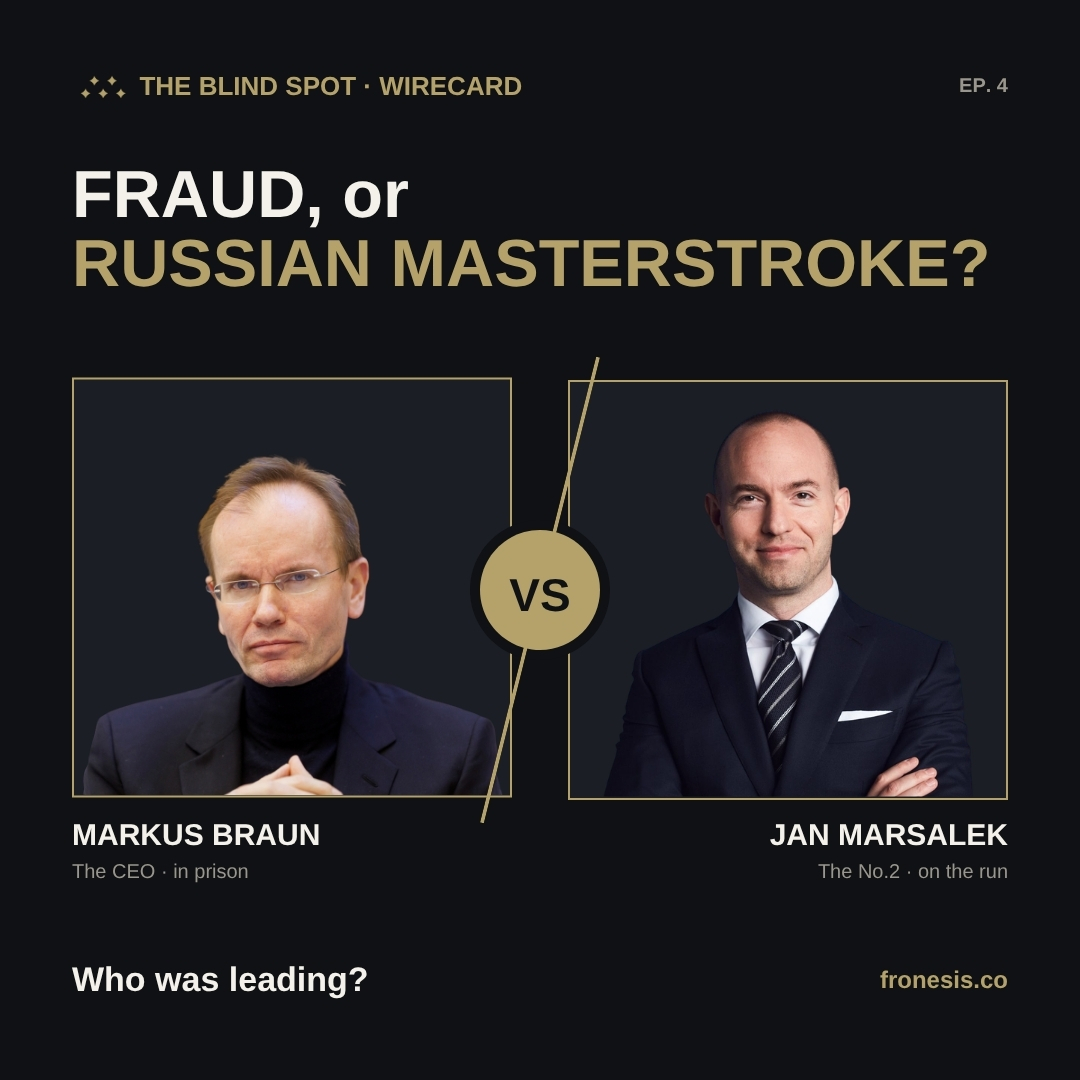
Wirecard: fraud, or a Russian intelligence masterstroke?
A CEO held in pretrial detention for six years. A second-in-command on the run, placed in Moscow by several investigations. 1.9 billion euros that never existed. Wirecard is Germany’s biggest financial scandal in recent memory, and one of the least told outside the country.
Here is what has been established, what has not, and what the case teaches anyone about to go into business with someone.
The story in brief
The rise. Wirecard was founded in 1999 near Munich and specialized in online payments. Jan Marsalek joined in January 2000 as a project manager. Markus Braun, a former consultant at KPMG Consulting, arrived in 2002 as CEO and chief technology officer. He became the largest shareholder, with more than 7% of the company. Marsalek joined the management board in 2010 as chief operating officer. In 2018, Wirecard entered the DAX.
The fall. According to Munich prosecutors, the figures were inflated from 2015 at the latest, through fictitious revenue attributed to partners in Asia. On that basis, around 3.2 billion euros were raised from German and Japanese banks and other investors, most of it now lost. In June 2020, 1.9 billion euros supposedly held in trust accounts turned out not to exist. Wirecard filed for insolvency.
The trial. Markus Braun has been in pretrial detention since 2020. His trial opened in Munich in December 2022. He denies all charges and says he was the victim of a gang led by Marsalek. He faces 10 to 15 years in prison; a verdict is expected in the coming weeks.
The escape. Jan Marsalek left Germany in 2020 and is the subject of an Interpol red notice. According to several investigations, he lives in Moscow and works for Russian intelligence. In 2024, a British court described him as the coordinator of a Bulgarian spy ring whose members were convicted. The press also suspects him of financing militias in Libya; none of this has been proven.
Who was leading?
The German court will decide on Markus Braun’s criminal responsibility.
What follows is my reading as a physiognomist: it is about profiles, not guilt.
Markus Braun. His problem, as I see it, is that he wanted to get there fast. Fast success, fast money. That kind of urgency makes anyone easier to steer (especially when holding more than 7% of the company).
Jan Marsalek. Extremely intelligent, very cautious, and someone who sees very far ahead.
My hypothesis. Marsalek arrived two years before Braun. Nothing proves he played any role in Braun’s appointment. But I wonder whether he knew how to make use of a CEO in such a hurry.
In Braun’s place, would you have suspected you were being manipulated? Or would you have found the idea ridiculous, almost conspiratorial? That is often where everything is decided.
The signals visible before the fall
The scandal did not erupt without warning. Several signals were public years before June 2020:
- Press investigations from 2015. The Financial Times questioned Wirecard’s accounts, especially its business in Asia.
- A crackdown on critics rather than answers. In February 2019, the German regulator banned new short positions on the stock, an unprecedented move. It then filed a criminal complaint against Financial Times journalists. Prosecutors dropped the case in 2020.
- Reliance on opaque partners. A large share of revenue came through third-party partners, far from headquarters and hard to verify.
- Personal fortunes tied to the share price. Braun’s stake was worth more than 1.6 billion euros in 2018, and part of it secured a personal loan of 150 million.
None of these signals proved fraud. But together, they pointed to a question few people wanted to ask: who here benefits from nobody looking too closely?
Before you partner
Wirecard is not a story about numbers. It is a story about people: who thinks they are in charge, who really is, and who knows how to use the other’s weaknesses.
Before you sign, ask yourself:
- Who was here before me, and what do they know that I don’t?
- My own weaknesses: who around me could use them?
- The money I am being shown: have I checked it myself, or only on paper?
- If my partner disappeared tomorrow, what would I really know about them?
That is what FRONESIS is for: reading people before you commit.
A decision to de-risk before you sign? Contact FRONESIS
Sources
This page will be updated after the Munich court’s verdict.
- BKA, wanted notice for Jan Marsalek
- beck-aktuell, the Munich trial
- Tagesspiegel, Markus Braun’s interview with Der Spiegel
- Wikipedia, Markus Braun
- Wikipedia, Jan Marsalek
- NBC News, the Bulgarian spy ring
- Libya-Analysis, citing the Financial Times
- Bloomberg, the short-selling ban
- AP, prosecutors drop the case against the journalists
Join the discussion One Comment